
Table of Contents
- Are Handmade Tumblers Worth the Price? The Short Answer
- What a Handmade Tumbler Price Actually Pays For
- Handmade vs Mass-Produced Tumblers: A Like-for-Like Comparison
- How to Assess Handmade Quality and Spot Misleading Listings
- Custom Tumbler Design Ideas That Justify the Upgrade
- How to Care for a Stainless Steel Tumbler So It Lasts
- Long-Term Ownership Costs and Repairability
- Conclusion
- Frequently Asked Questions
Last Updated: October 18, 2026
Are Handmade Tumblers Worth the Price? The Short Answer
Yes, handmade tumblers are worth the price when you value the design work, the small-batch production, and a cup that does not look like everyone else's.
The question "are handmade tumblers worth the price" usually comes down to one thing: what separates a $20 handmade tumbler from a $6 mass-produced cup on a big-box shelf.
Below, we break down exactly what a handmade tumbler price pays for, how it compares to mass-produced drinkware, and how to spot a listing that is not what it claims.
What a Handmade Tumbler Price Actually Pays For
A handmade tumbler price covers three buckets: raw materials, labor, and design time. The stainless steel blank is the smallest line item. The hours are the biggest. Most guides stop there, which leaves you unable to judge whether a quoted price is fair. Here is the transparent breakdown competitors skip.
Materials, Labor, and the Time Behind Each Cup
Start with the raw materials. A double-wall stainless steel blank, a lid, and a straw are commodity parts, and most makers buy them from the same handful of suppliers.
Labor is different. Applying a full-wrap design by hand, aligning artwork around a curved surface, and finishing the seams takes real time.
Design time is the invisible cost. Someone has to draw the artwork, pick the color palette, and test how it looks wrapped around a cylinder.
A Transparent Line-Item Breakdown of a $20.00 Tumbler
To judge whether a price is reasonable, separate what you pay into the costs a maker actually carries. The exact numbers vary by supplier and design complexity, but the structure is consistent across small shops. Using a $20.00 handmade tumbler as the example:
| Cost line | What it covers | Typical share of a $20.00 price |
|---|---|---|
| Blank, lid, and straw | Double-wall stainless steel cup and lid assembly from a wholesale supplier | Roughly $4.00-$7.00 |
| Design and artwork | Original illustration, color selection, and test wraps | Roughly $1.00-$3.00 per unit at small volume |
| Labor | Hand application, alignment, seam finishing, and inspection | Roughly $4.00-$8.00 per unit |
| Packaging | Box, insert, and protective wrap for shipping | Roughly $1.00-$2.00 |
| Marketplace and payment fees | Platform commission and card processing | Roughly $1.50-$3.00 |
| Overhead | Equipment, software, shipping supplies, and shop costs | Roughly $1.00-$2.00 |
| Maker margin | What remains to reinvest and pay the maker | The remainder |
Read the table as a structure, not a promise. A maker who sells at $20.00 with a complex original design is running thin margins; a maker at $45.00 may be covering more design time, premium packaging, or personalization labor. The point is that a fair price maps to visible costs, and a listing that cannot explain its price is the one to question.
Typical Asking Prices and What They Signal
Handmade drinkware generally lands in a range, and the position within that range tells you something. Lower prices often mean a simpler design or a stock graphic. Higher prices usually mean original artwork, personalization, or a more involved finishing process.
What most guides miss is that price alone does not prove quality. A high asking price with a vague listing is a warning sign, not a guarantee.
Handmade vs Mass-Produced Tumblers: A Like-for-Like Comparison
Comparing handmade and mass-produced tumblers fairly means holding both to the same standards: insulation, leak resistance, finish, durability, and long-term cost. On the physical basics, they are closer than most people expect.
Most stainless steel tumblers, handmade or not, use double-wall vacuum insulation. The construction is similar because the blanks often come from the same supply chain. Where they diverge is the surface: the design, the coating, and how it holds up over months of use.
| Feature | Handmade Tumbler | Mass-Produced Tumbler |
|---|---|---|
| Design | Original artwork, small-batch | Stock graphics, high volume |
| Personalization | Common, often built into the order | Rare or limited to text |
| Insulation | Double-wall vacuum on quality blanks | Varies widely by price point |
| Finish | Hand-applied, inspected in small batches | Machine-applied, consistent |
| Replacement | Maker may repair or reorder | Buy a new one |
| Best for | Gifts, personalization, uniqueness | Bulk, budget, disposability |
Insulation, Leak Resistance, and Finish
Insulation performance depends on the blank, not the artwork. A well-made double-wall stainless steel tumbler keeps drinks cold for hours whether a machine or a person decorated it.
Leak resistance comes down to the lid. A slide lid or screw lid from a reputable supplier performs well.
Finish is where handmade pulls ahead. A maker handling each unit can catch a crooked wrap or a bubble that a factory line would miss.
How to Test Both at Home
You do not need a lab to compare a handmade tumbler against a mass-produced one. Run the same simple checks on both:
- Ice retention. Fill each tumbler with ice and water, leave both at room temperature, and note how long ice remains. A quality double-wall blank should still hold ice after several hours; a thin single-wall cup will not.
- Leak check. Fill with water, seal the lid, and turn the tumbler upside down over a sink for a minute. Any drip at the lid seam is a fail.
- Finish inspection. Run a fingernail lightly across the design edge. A hand-applied wrap that is properly sealed feels smooth; a lifting edge catches.
- Lid fit. Twist and pull the lid gently. A lid that rocks or lifts easily will leak in a bag.
A common pattern is that the blank determines insulation and leak performance, while the maker determines finish quality. Test both so you know which part of the price you are actually paying for.
Lifespan, Replacement, and Long-Term Ownership Cost
This is the part of the comparison most guides skip.
Do the math over time. A $6.00 mass-produced cup replaced twice a year costs about $12.00 annually and roughly $36.00 over three years, with no personalization and no repair path.
The trade-off is lead time. For a gift with a deadline, order early and confirm the timeline with the maker directly.
Highland Cow 20 oz Stainless Steel Skinny Tumbler →
How to Assess Handmade Quality and Spot Misleading Listings
Assessing handmade quality comes down to evidence: real photos, clear specs, and a maker who answers specific questions.
Use this checklist before you buy:
- Does the listing show a photo of a finished tumbler, not just a digital mockup?
- Is the capacity stated in ounces, and does the lid type match the photo?
- Are care instructions listed, including whether it is dishwasher safe or hand wash only?
- Does the seller explain how personalization works and how long it takes?
- Can you see the design from more than one angle?
A common mistake is assuming "handmade" means "one of a kind." Some makers apply original art by hand; others personalize a stock design.
For guidance on labeling and honest product claims, the Federal Trade Commission advertising guidelines are a useful reference for what sellers should and should not promise.
Custom Tumbler Design Ideas That Justify the Upgrade
Custom tumbler design ideas earn their premium when the design means something to the person receiving it. A name, a date, a shared joke, or a favorite motif turns a cup into a keepsake.
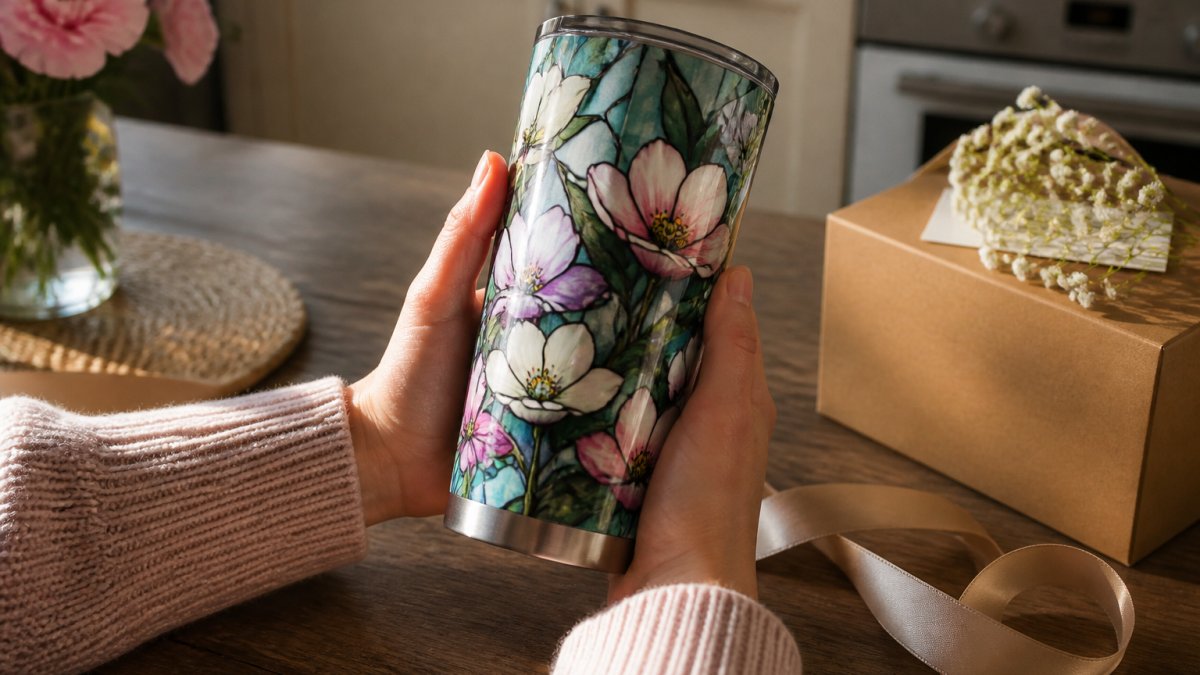
Here are directions that hold up well for gifts and everyday use:
- Milestone dates. A wedding date or anniversary wrapped around the cup.
- Floral and botanical art. Stained-glass-inspired florals, like our Stained Glass Lily tumbler, suit anniversaries and Mother's Day.
- Nostalgia themes. Storybook and childhood motifs, such as our Storybook Bear Mosaic tumbler, land well with gift-givers.
- Animal and hobby designs. Our Highland Cow tumbler fits farm and animal lovers.
- Message-driven art. A simple phrase, like our Bee Kind tumbler, works as a daily reminder.
If you do not have a specific vision, that is normal. A good maker will help you narrow the direction before production starts.


How to Care for a Stainless Steel Tumbler So It Lasts
Caring for a stainless steel tumbler is simple, but the details depend on the finish. Always follow the maker's instructions, because a dishwasher-safe blank and a hand-applied design are not the same thing.
General care rules that apply to most tumblers:
- Wash by hand with mild soap and warm water when the design is hand-applied.
- Skip abrasive sponges, which can dull a printed or coated surface.
- Do not soak for long periods, and dry the lid thoroughly.
- Avoid extreme temperature swings, like pouring boiling water into a cold cup.
Our Highland Cow and Bee Kind tumblers are listed as dishwasher safe. Our Storybook Bear Mosaic tumbler is hand wash only to preserve the design. That difference is exactly why you should read the care note on each listing rather than assume.
Long-Term Ownership Costs and Repairability
Long-term ownership cost is where a handmade tumbler often wins. A cup that lasts years and can be reordered or repaired beats a cheap cup you replace every season.
Mass-produced tumblers are usually disposable by design. When the finish chips or the lid breaks, you buy a new one.
The trade-off is lead time. Custom orders take longer than grabbing a cup off a shelf, so plan ahead for weddings and holidays.
Conclusion
The honest answer is that handmade tumblers are worth the price when design, durability, and personal meaning matter more to you than the lowest possible cost. You are paying for original artwork, small-batch attention, and a maker who stands behind the piece.
At Lynne's Creations, every tumbler starts at $20.00, with double-wall stainless steel construction, a lid and straw included, and custom order options for personalization.
Frequently Asked Questions
Why are handmade tumblers more expensive than mass-produced ones?
A handmade tumbler price reflects small-batch production: raw materials bought in low volume, hours of design and finishing time, and one person checking each unit instead of a factory line. Mass-produced cups spread those costs across thousands of units. The premium you pay covers labor, custom artwork, and the fact that no two pieces are identical. It is a different cost structure, not a markup for the same product.
Do handmade stainless steel tumblers keep drinks cold longer?
Insulation depends on the double-wall vacuum construction, not on whether the tumbler is handmade. A well-made handmade tumbler built on double-wall vacuum stainless steel holds temperature comparably to a mass-produced cup of the same spec. Ask the seller about the wall construction before buying. Lynne's Creations tumblers, for example, use double-wall vacuum insulation and 20 oz stainless steel bodies designed to hold drinks at temperature for hours.
How can you tell if a handmade tumbler is good quality?
Check four things: the weight and feel of the stainless steel body, whether the lid seals without wobble, whether the design sits flush with no peeling edges, and whether the seller lists care instructions. Ask for real photos of finished pieces rather than mockups. A maker who answers questions about materials and production time is usually a maker who stands behind the work.
Is a handmade tumbler a good gift?
It works well for weddings, anniversaries, housewarmings, and birthdays because the personalization carries meaning a store-bought cup cannot. Order at least six to eight weeks ahead if you need a custom design, and confirm lead times in writing. A 20 oz personalized tumbler with a design matched to the recipient's interests tends to get used daily rather than stored in a cabinet.
The real challenge is finding drinkware that feels personal without guessing what will arrive in the box. Lynne's Creations solves that with handcrafted stainless steel tumblers, custom order options, and expressive, gift-ready designs you can see before you buy. Get started with Lynne's Creations and give a gift that carries a little artistry into everyday moments.